In Pre-production
“When the painting begins to take over, and paint itself…I’m just watching it happen…pure wonderment” – John Winslow
Wonderments Short Proposal (PDF)
JOHN WINSLOW’s “WONDERMENTS”…
A DOCUMENTARY OUTREACH PROJECT
PROJECT PROPOSAL Date: March 17, 2026
Media Policy Center | IRS 501(c)(3) Nonprofit Production Entity:
Please, your donation: thru Your BANK; ZELLE transfer code: mpc@mediapolicycenter.org
1434 18th Street, Santa Monica, CA 90404 (www.mediapolicycenter.org)
Dale Bell, Executive Producer | Director | DP
dale@mediapolicycenter.org | 818-398-4562
Rosemary Winslow, Co-Executive Producer | Co-Writer
maypoet49@gmail.com | 202-819-6648
Betsie Garcia, Producer
betzgarcia643@gmail.com | 805-266-5414
William Lynn Wallace, Legal: wlynnwallace@gmail.com l 202-494-2543
Ralph Herman, Editor/Producer: rlaherman@gmail.com l 818-802-8516
Dominik Yoder, Composer: l 323-222-1069
Resumes and budget available upon request.
wonderments.net (Coming soon)
John Winslow, husband, father, painter, teacher and humanist, passed September 1, 2024, after creating brand new worlds of “Wonderments” on his hundreds of canvases, all 316 digitized, and in the minds and hearts of students and collectors everywhere.
Hello. We are in first-phase fund-raising for a major documentary about John Winslow, seeking $25,000 to be committed by April 15, to continue 10 days of filming in DC in mid-May, requesting at least 9 grants of $2,500, through Zelle to our 501c3. (We have our first grant.) Please become a “first donor”, join the Board of Advisors. Details below. Thank you very much.
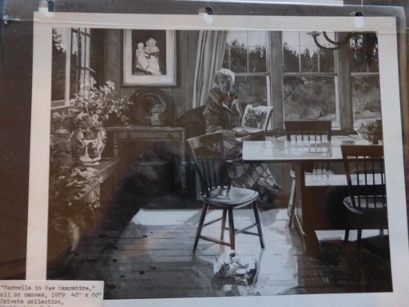
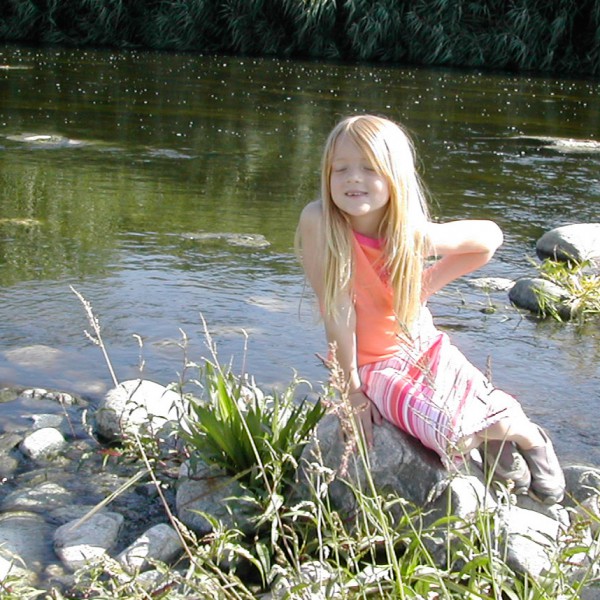
Much earlier, in his loving mind as a young boy. he and his older sister, Mary, invented a new language— “Massarel” named after their pet dog Massa,— so as two inhabitants in a world they had freshly created, they could privately communicate their “Wonderments” at home in Washington, D.C. Far away, World War II was ending. Their mother, Marcella Comès, daughter of a well-known architect of Catholic churches, many in the Pittsburgh area, had trained at Carnegie Institute of the Arts as a portraitist. To know the great masters and churches, her father takes the family to Italy to extend her vision. She learns.
One day, Marcella’s subject is a recent West Point graduate, William Winslow. She realizes soon, and he, too, that they are falling in love. William, following his family’s calling, was in the military. They marry in 1935. Both Mary and John are born before William enters World War II. Surviving combat in the Battle of the Bulge, William, now a Colonel, contracts pneumonia that kills him, just before the end of the war. His life with his two children is brief. Marcella grieves over her husband’s early death, but stoically, picks up her paint brush, and copes with her new life as war-widow and mother. Their house at 3106 P Street becomes a salon, filled with poets, writers, painters, politicians, and luminaries. She becomes the portrait painter of the US Poet Laureate, and many others. Surprise, she is also a photographer! She is creating “Wonderments” for her children and for the leaders of our civilization. We have her book; daughter, Mary, remembers well.
John secures a scholarship to Andover, deeply admires Frank Stella’s work ethic 2 years ahead of him, competes in swimming and track. In 1956, John enters Princeton in architecture, graduates, then enrolls in the Yale University Art School to pursue painting. He picks up a second bachelor’s degree. The painter Joseph Albers influences every aspect and methodology of his painting. In 1961 he marries classmate Susan Haeberlin, begins a family of four in New Haven. In 1963, he receives a Master of Fine Arts from Yale. Though architectural rendering for the New Haven Redevelopment Agency may pay the “new family bills”, it is remote from actual painting. He agonizes.
In 1969, he secures a dual-track assignment at Catholic University of America (CUA) where Ken Noland had taught, and returns to DC. His assignments: teach architectural rendering to architecture students; teach painting and drawing to art students. He is frantically busy, painting portraits and realist works that sell and supplements his meager CUA salary. He gains critical notice and longs to have time and be free of heavy financial responsibilities, thus freeing up time to explore synthesizing realism with the abstract expressionism learned in the Joseph Albers-led M.A. program at Yale.
1981, he divorces. Moving back into 3106 P Street with his mother, he converts a garage into a studio, sets up his easel– and begins to paint feverishly. John sees that he can provide for his children’s education (also at CUA) and explore. Driven, he turns out work that begins to combine realism and abstraction. His children mature. Three days a week, he teaches at CUA. Every spare hour is devoted to the creation of wonderments–hopefully to supplement his CUA’s professor salary. Mirroring his mother, he also pursues portrait commissions. He puts his children through college. His children are grown.
He takes an inspirational trip to Perugia, Italy, where abstraction suddenly begins to enter his landscapes. The Italian paintings sell out. He takes years to explore how abstraction can settle in the same canvas as realism. Images from the great masters enter the paintings as spots of memory alongside images of everyday life. But a coherence is yearned for, not yet arrived.
At the end of the 1980s, John meets a dynamic kindred spirit, Rosemary Gates, a professor/PhD, researcher, lyric poet, and writer, in CUA’s lunchroom. They discover their harmony and marry in 1994, honeymooning at the home of his grandmother, Anne Winslow, mother of his father whom he barely knew, and a famous writer who held salons for literati luminati. Back in DC, the newly-weds John and Rosemary explore “deep beauty” from their “Crow’s Nest” perch above M Street, not far from where he grew up. The top floor of the renovated rowhouse has light, air, space, and insulation from the real world. It is their creative haven. They do not begin to develop a new Masserl language, but the harmony in their dual discipline is now complete and whole. Finally. Wonderments achieved. The daily political DC turbulence is ignored. At last, when he finds time, he knocks out NYTIMES Sunday crossword puzzles in less than one hour!
John begins to draw attention as a master painter, hearing “masterworks” applauded in his gallery shows. Remarkable comments begin to sprout and echo throughout the art worlds. “Exceptionally skilled!” he hears repeatedly. He is launched. He mounts large solo exhibitions every two years. He is finally achieving his vision, synthesizing the flatness of abstraction and a realist deep space inhabited by the human figure in architectural grounding.
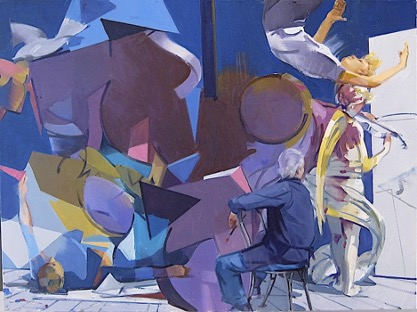
Rosemary told me that love and inspiration provided the foundation of their 30-year romance marriage and collaboration: John worked to bridge the major streams of art into a vision that represents the workings of the mind—the swirling churning streams of human energy and thought, the real in the imagined, the past in the present. This process is the way human consciousness flows, presented in John’s work by the process of bursting intrusions of form and color into surfaces, the layers of streams figured in translucent overlaps of objects, and collapsed time and space where human figures stand, sit, float, work and play in a joyful release from ordinary reality yet are grounded within reconstructed architectural planes. These concepts are central to twenty-first century education where creativity and imagining possibilities, critical for our present and future existence, entangle. While preserving ideas and cultural moments from our past, he envisioned a transformation of energy driving historical cultural expression toward a renewed freeing of human possibility through creative dislocation and relocation in time/space.
February 7, 2026 quotes from Ben Forgey, art critic, Washington Post at Katzen Gallery:
He was such a tremendously skilled painter… he painted light, structure, and space with complete authority. He could portray a room like nobody else.
He made an altogether ordinary scene extraordinary just because he painted it.
All great artists have to be unique in some way, have a quality that commands attention—and John had that.
His struggle was almost heroic—day after day doing his duty to bring realism and abstraction together in a meaningful way.
Realism transformed—that’s what his art was all about.
***
Hello. I’m Dale Bell. On behalf of my team, I am writing to you, with some urgency—because we want to continue filming interviews with family, collectors, gallery people, and historical critics, for an additional ten days in DC in mid-May and elsewhere, and to immediately begin our editing of a short film for further fund-raising. John’s hundreds of paintings and sketches have been digitized; his written words, videos, and áudio captured; we possess the ability to convey his “process”. Now, we request funds—$25,000 to be confirmed by April 15. (We have received our first $2,500; nine more identical amounts to go. Funding guidelines will adhere to PBS standards.)
You could also recommend to us other funders who could create a consortium of possible funders/distributors— (individuals, foundations, corporations), for “WONDERMENTS” consisting of: a documentary, 60-90 minutes, PBS style, supported by shorter educational and communitarian components linked globally with art and humanist institutions, including a companion book written by Rosemary.
We are creating a Board of Advisors to guide the fund-raising and content creation/distribution. They will concurrently connect us with: additional funders; the art worlds; the institutional organizations; the publishers; the collectors; the potential PodCast families; the public relations teams; the students; the galleries; the distributors; the archivists; the community organizations like AARP, The Art Students’ League, the 20th Century Club, the Fred Rogers Institute in Pittsburgh. Our flexible format ensures the film can serve multiple audiences while maintaining artistic integrity. WONDERMENTS, the John Winslow Archive and Educational Initiative, expands the documentary beyond a singular cinematic portrait and positions it as the fountain of a living intellectual ecosystem.
The total cost for the WONDERMENTS film will be about $450,000 and will require about 18 months to complete and distribute through television and/or theatrical sources, by my 501(c) (3). You can transfer through your bank’s transfer/Zelle; the code is mpc@mediapolicycenter.org We will create a comprehensive digital archive of John Winslow’s works, as well as develop an educational K-12 and university-level initiative program of outreach components, derived from the edited film, based on his philosophy and art, to deal with aesthetic and ideological issues of the role of art and WONDERMENTS —the refreshing of the mind and spirit—in our lives.
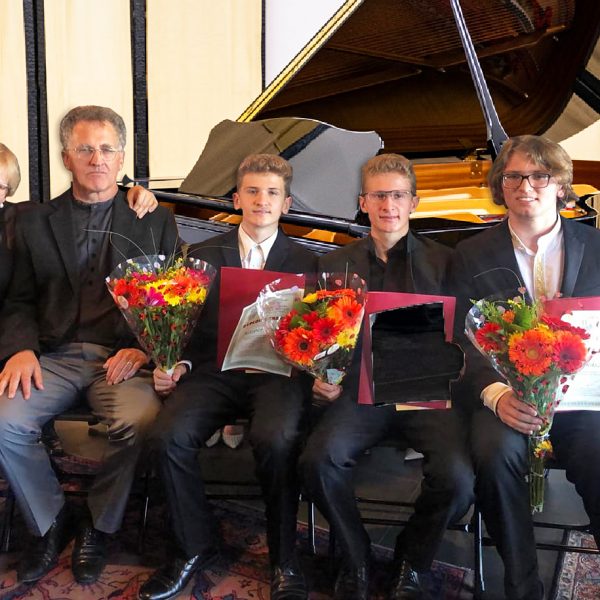
A musical score, created from Chopin’s piano works, will be composed and performed on the piano by Dominik Yoder, young, brilliant piano competition-winner, later available as a performance piece —John Winslow’s Wonderments—and outreach inspiration. Dominik qualifies. A magnet for young people seeking beauty in their lives.
I, Dale Bell, am a producer of the movie, Woodstock, that won the Academy Award in 1971 and led to the formation of the Woodstock Nation soon thereafter. Wonderments. My other awards include four BAFTA Awards for The Chronicles of Narnia with the BBC, a Peabody Award for Dance Theatre of Harlem’s Firebird, multiple Emmy Awards and Christopher Awards for the PBS performance series Kennedy Center Tonight (1981-84), among others.
My college roommate at Princeton (1960) was John Winslow, not a filmmaker but a painter of such pioneering, extraordinary vision and complexity, he could have well converted his complex canvases—and Wonderments— to films. As roommates, he in art and architecture, me in theatre, both of us connecting differently to Frank Stella’s work, we encouraged each other to draw regularly. My senior thesis—Six Characters in Search of an Author by Luigi Pirandello—an examination of reality and fiction, later a stage play starring Maria Tucci—became a huge personal canvas under John’s brush and palette. (He changed “author” to “auteur”.)
John and Rosemary, both very active multi-talented professors at CUA, explored their love story across many levels. When I visited them, I would choose to sleep on the sofa in the studio, to inhale the turpentine, to survey the new work in the easels, to be close to the creative processes. On September 1, 2024, my last call, Rosemary, astonished at my timing, said I caught John in “transition”. He passed THREE HOURS later, at age 86. Rosemary still grieves, and writes, and remembers with her friends and colleagues, collectors, and critics.
I am a storyteller. John was too. Different media. I told Rosemary that I would make a film about John’s soul, his many works, his collectors, his inspiration, his pursuits, their relationship, their twin lives in DC and in Center Sandwich, NH where John used to visit frequently as a young man. I invited Rosemary to join me as Co-Executive Producer and Co-Writer of this film.
Promise to Tell the Story
The project is being developed by the not-for-profit production entity, Media Policy Center (IRS 501 (c) (3)) sanctioned in 2003, Ashoka-honored in 2004, ZELLE: mpc@mediapolicycenter.org), based in Santa Monica, responsible for the production and distribution of some 7 major PBS social justice projects (comprising almost 100 individual titles) beginning with AND THOU SHALT HONOR (2002) which is now in global distribution. www.mediapolicycenter.org
Please help us if you can and/or guide us to secure funding to continue our progress. John’s art, Rosemary’s words and their love comprise the soul of this film and project, another example of collaboration in ideas and concepts. We are grateful. Our production team consists of Betsie Garcia as Producer, Pierre Kattar and Mark Finkelpearl (for their work with us on February 7&8 in DC), Ralph Herman as Editor/Producer, myself as Camera, Director, and Exec Producer/Writer with Rosemary. Dominik Yoder will compose and perform the score, created from Chopin’s piano works. Resumes and budget are available on request.
Thank you, Dale Bell
Winslow, we realize, is an asker of questions, a juggler of possibilities who is, nonetheless, very clear about his values. He asks us to ponder these complex, interwoven dreamworlds so that we can join him in his ongoing discussion about the nature of art. — Ben Forgey, Former Art Critic for The Washington Post
Who was John Winslow? by Betsie Garcia, Producer:
John Winslow (1938–2024) was an American painter whose work stood at the intersection of rigorous abstraction and lived experience. Born in 1938 in Washington, D.C., Winslow grew up in an environment shaped by art and intellectual curiosity. His mother, Marcella Comès, supported the family as a portrait painter, fostering in him an early relationship with materials, presence, and visual intuition.
Winslow’s lifelong commitment to art was marked by a persistent inquiry into form, space, and human consciousness. Rather than seeking commercial success, he pursued visual intelligence — a way of seeing that honored both the discipline of craft and the depth of thought. His work evokes movement, architectural tension, and layered perception; its forms are not decorative but contemplative. WONDERMENTS.
For more than three decades, Winslow taught studio art and architectural design. He was known as a demanding teacher and deep thinker, a mentor who encouraged students to engage with simplicity, complexity, process, and reflection. His influence extended far beyond the classroom, shaping the creative paths of generations of artists.
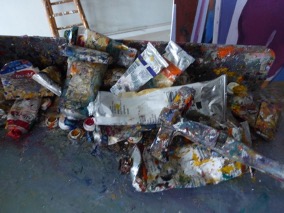
Winslow’s final studio, workplace and laboratory, put him overlooking Washington. The space, filled with brushes, canvases, and ongoing exploration, was testimony to a practice rooted in immersion and material presence. His life in the studio was inseparable from his way of thinking: persistent, patient, humble, peaceful, gentle, and always seeking the internal logic of an idea made visible.
Colleagues, students, and critics consistently noted Winslow’s unique capacity to fuse abstraction with inhabited experience. His paintings do not simply present form; they invite the viewer into a psychological and spatial conversation. Time, memory, and architecture converge in surfaces that reveal layered intention, the past within the present, structure within flux. A Wonderment.
For more than thirty years he lived and worked with his wife, Rosemary Winslow, a lyric poet whose own practice shaped and enriched their shared creative world. Together they inhabited overlapping intellectual spheres that balanced poetry and painting, thought and feeling, discipline and imagination.
John Winslow passed away at the age of eighty-six, leaving behind a body of work that resists easy categorization but that rewards sustained attention. His legacy lives in his paintings and in the many artists he taught, mentored, and inspired….A WONDERMENTS RELAY RACE.
Why This Film Now?
We are living through a profound technological and cultural inflection point. Artificial intelligence systems can now generate images in seconds that mimic the surface aesthetics of a painting. In this current environment, the question of what makes art meaningful has reemerged with resounding urgency.
In a recent episode of The Art Angle Podcast, art critic, cultural theorist and technologist Mike Pepi argued that what makes art valuable is not simply its visual output but the human conditions that shape it: the life of the artist, the discipline of the craft, the intellectual formation, and the lived experience that informed the work. He warns that certain sectors of the AI world adopt an anti-humanist posture, prioritizing technological proof over the human experience embedded in artistic creation. This cultural moment has then built the following question which I think may be the core theme of this documentary project:
What remains uniquely human in art?
John Winslow’s life and work offer a powerful response. Winslow represents a generation of artists whose practice was rooted not in spectacle or rapid production, but in discipline, philosophical inquiry, and sustained studio labor. His abstraction was not decorative. It was intellectual. It demanded time, interpretation, and engagement. It required the viewer to wrestle with form rather than consume it. In a digital era defined by immediacy, replication, and algorithmic image generation, Winslow’s commitment to craft, materiality, and philosophical enlightenment feels increasingly urgent.
Institutional Reassessment and Archival Urgency
Museums and cultural institutions are currently reassessing twentieth century narratives. There is a growing appetite for artist-centered retrospectives that recover overlooked figures whose impact was regional, pedagogical, or institutional rather than market driven. Simultaneously, the urgency of archival preservation has intensified. Artist estates that are not embedded within institutions risk fragmentation or obscurity. Creating documentary film anchored by an educational infrastructure provides a mechanism for institutional integration rather than posthumous marginalization.
Generational Shift in Art Discourse
Younger audiences are navigating a landscape saturated with images yet starved for depth. There is renewed interest in process, authorship, and artistic biography precisely because the culture is flooded with automated outputs. Art remains intrinsically human. It embodies imagination, labor, vulnerability, and philosophical inquiry. While machines may replicate aesthetic surfaces, they cannot replicate lived experience. WONDERMENTS are created by humans who love.
This documentary positions John Winslow not as a nostalgic figure of the past, but as a case study in artistic integrity, intellectual seriousness, and the enduring relevance of abstraction in a technologically accelerated era. The documentary arrives at a moment when people and art institutions are being challenged to redefine their purpose, when audiences are questioning authorship, and when the human presence within creative work must be articulated with clarity. Capturing and documenting John Winslow now is not an act of memorialization alone. It is an intervention in contemporary cultural discourse. The process of creating WONDERMENTS needs to be recognized. Essential. They provide fresh experiences. Is John’s life-long work and practice reassuring his father that he, his sister and Mom, are truly OK? Find out.
The central premise of this initiative is that art is not merely a platform for display. It is an active system of transmission and engagement. John’s paintings, teaching philosophy and rigorous studio discipline fostered not passive viewership, but intellectual and spiritual engagement. Welcome.
From collector, BRUCE WEBER, February 8, 2026, Silver Spring, MD…
Bruce and his wife, Joan, have some 20 Winslow paintings:
We’re sitting with a brilliant mind who produced fascinating, layered work—skillfully rendered and done with the compulsion he had to paint.
You cannot NOT make art when you’re a John Winslow.
For me, good paintings are about a problem an artist poses—and the painting resolves that problem. That’s why I think John is a brilliant artist.
John is working through very abstract, very intellectual problems—and resolving them in fascinating ways I never would have conceived.
One of my rules was: the work has to make me see the world new. And John [Winslow] does that.
He’s an active maker of a reality in his paintings.